

Growing Up Maasai in a Changing Climate: A Journey Through Tradition, Loss, and Resilience
By Benson Sinkoi
I was born about twenty-two years ago in the dusty plains of Amboseli, in Southern Kenya—a place where the horizon meets the mountains and where culture breathes through every sunrise. To be born Maasai is to be born into rhythm, responsibility, and reverence. Our land is not just where we live; it is who we are.
From my earliest memories, I belonged to a community deeply rooted in orkuak, the guiding force of Maasai cultural identity. In our worldview, tradition is not optional. It is sacred. It defines the boundaries of belonging, and whoever abandons it is believed to walk away from the community’s spiritual protection.
Life in those early years was vibrant and communal.
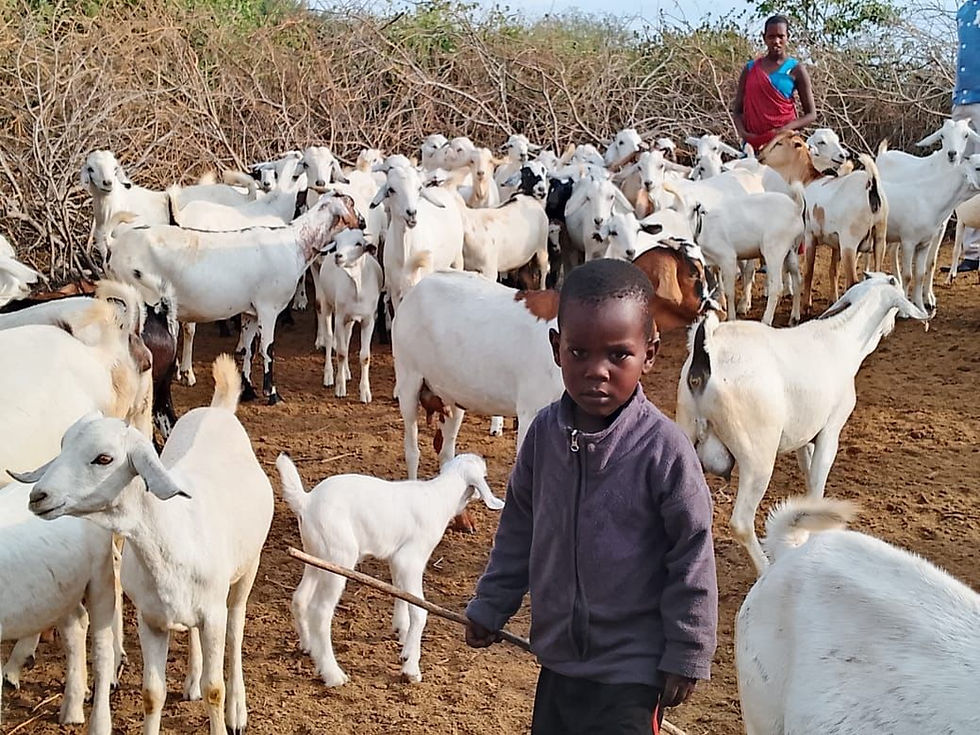
Boys grew into their strength by herding cattle and sheep across the open plains. To walk behind the herd—barefoot, spear in hand, dust swirling around you—was to walk in the footsteps of generations. It was a joyful responsibility. Your family’s livelihood, and indeed the dignity of the entire community, literally walked before your eyes.
Every Maasai boy saw his future in the cattle he led. One day, he would inherit his father’s herd, attend enkaputi, pay his bridewealth, marry, and become a father himself. Cattle were not just wealth; they were a pathway to adulthood, identity, and continuity.
Girls, together with our mothers, held the heart of the home. They fetched water and firewood, milked cows, maintained the homestead, and kept the household warm and alive. They carried burdens with grace, discipline, and unmatched resilience.
Ceremonies That Fed the Soul of the Community
Our traditional ceremonies—intalengo such as initiation, marriage, age-set transitions, and blessings— were central to who we were. They brought communities together under the blessed shade of acacia trees. The air would fill with celebrations, songs, feasts, and rituals that preserved the stories of our people.
Food was shared abundantly.
Milk, carefully stored in beautifully smoked enkoti (calabashes), circulated freely between households.
Meat, prepared at orpul—a designated sacred place for slaughter—was shared generously across the homestead and neighbourhood. No one returned home empty-handed. No one ate in isolation. Food— especially milk and meat—was a symbol of unity and abundance.
Life was not perfect, but it was whole, meaningful, and connected.
When the Land Begins to Change
Today, the life I knew—the life so many Maasai children grew up with—is changing rapidly. There is a striking difference between then and now.
Where once every family had cattle grazing freely across vast expanses, now only a small percentage of households still possess herds.
Where once milk filled every enkoti, now many homes struggle even to secure their daily meal.
Where once meat was shared with the entire community, today there are families that go days without it.
The communal herding of boys has faded. We no longer walk together with iremeta (spears) and rungus, guarding the herd, learning from each other, and forming lifelong bonds. Instead, herding increasingly happens individually on scattered ranches, separating boys from one another and eroding the social fabric that once held us together.
The places that were once centers of communal life—rivers, dams, springs, watering holes—are shrinking or disappearing. Children no longer meet at the river to water herds. Women no longer gather at the dam to fill gourds and exchange stories. Silence now covers these once-lively places.
Forests we depended on for herbs, firewood, and protection are thinning.
Grasslands once lush and abundant are turning bare.
The soil is eroding; the land is degrading.
What used to be natural cycles of seasons have become unpredictable shocks.
This Is the Face of Climate Change
For pastoralist communities like the Maasai, the effects of climate change are not theoretical, scientific, or distant—they are lived realities. They come in the form of droughts that wipe out entire herds, unpredictable rains that disrupt planting and grazing patterns, and heatwaves that dry up rivers faster than they can be replenished.
Climate change has altered the rhythm of life:
Long droughts kill cattle and leave families without livelihood.
Failed rains destroy pasture, forcing people to walk for days in search of grass.
Dried rivers and dams break communal bonds and daily routines.
Land degradation removes the very foundation of cultural practices.
Loss of biodiversity threatens traditional medicine and ecological knowledge.
Shrinking forests and conservation areas erase sacred sites and ecosystems we depend on.
And this is not unique to the Maasai. Across Indigenous communities—hunter-gatherers, forest peoples, small-scale farmers, and pastoralists—culture itself is under threat. Language, rituals, ceremonies, food systems, and environmental relationships face erosion at a pace never seen before.
The most painful irony is this:
Indigenous peoples contribute the least to global emissions, yet we are among the first and worst affected.
We are losing cattle not because of poor herding practices but because global emissions warm our skies.
We are losing water not because of mismanagement but because the planet is changing faster than the land can adapt.
We are losing culture not because we abandoned it but because climate change has disrupted the foundations that sustain it.
Still, We Do Not Give Up
Despite the hardship, the Maasai community has shown extraordinary resilience. We have reached inward to the knowledge of our ancestors—centuries of Indigenous environmental understanding—to navigate these challenges.
Our people are adapting through:
Traditional grazing patterns that revive degraded lands
Indigenous weather forecasting using stars, winds, insects, and animal behavior
Rotational pasture use to restore ecosystems
Water conservation strategies
Sacred ecological practices that protect forests, grasslands, and springs
Communal decision-making to safeguard remaining resources
This Indigenous knowledge, tested through generations, has become a lifeline. In my next article, I will share the powerful Indigenous Maasai solutions that can help communities adapt to climate challenges—not just here in Kenya, but across the world.
But before that, I must say this clearly:
We have suffered greatly because of climate change. And tragically, we are not the ones causing it. Yet we continue to bear the heaviest burden.
Still, we rise with wisdom.
Still, we rise with hope.
Still, we rise with the spirit of our ancestors guiding us toward resilience.


Comments